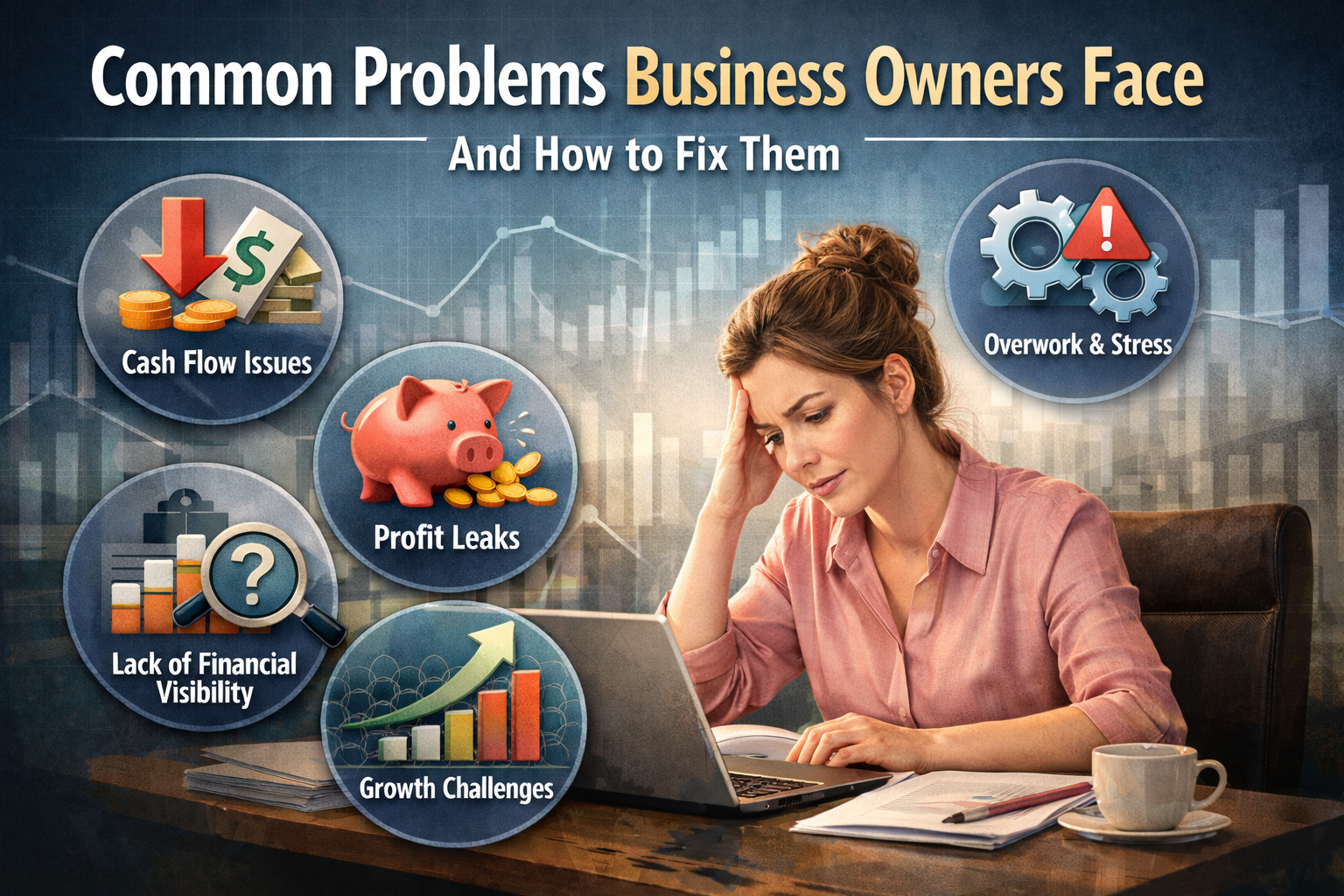
The Hidden Problems Most Business Owners Are Fighting (But R
From the outside, running a business can look like freedom, success, and control. Inside the day-to-day reality, many owners are navigating pressures that rarely make it into social media posts or networking conversations.
Whether a company is just stabilizing or already generating strong revenue, the challenges tend to follow familiar patterns. Understanding these friction points is the first step toward fixing them — and toward building a business that actually supports the owner, not the other way around.
1. Cash Flow Uncertainty — Even When Revenue Looks Strong
One of the most misunderstood truths in business is this:
Revenue does not equal cash availability.
Owners frequently experience:
Money coming in… but disappearing just as fast
Irregular income cycles
Surprise expenses
Tight payroll or vendor timing
This creates constant low-grade stress. Many businesses that appear healthy on paper are operating with fragile liquidity behind the scenes.
2. Hidden Profit Leaks
Small inefficiencies compound over time. Pricing gaps, vendor terms, operational waste, or underused assets quietly drain profitability.
Most owners are so focused on growth that they overlook optimization. The result:
Margins thinner than expected
Hard work not translating into take-home income
Scaling that feels harder than it should
Often, these leaks aren’t dramatic — they’re subtle and systemic.
3. Wearing Too Many Hats
Entrepreneurs frequently become:
CEO
Operations manager
Sales lead
HR
Finance department
This overload slows decision-making and creates burnout. Strategic thinking gets pushed aside by urgent tasks, leaving the business reactive instead of intentional.
4. Growth That Outpaces Structure
Ironically, success can create its own strain.
As revenue grows, businesses often experience:
Systems that no longer scale
Processes breaking under volume
Staffing strain
Increased complexity
Without infrastructure catching up, growth becomes chaotic instead of profitable.
5. Lack of Clear Financial Visibility
Many owners operate with partial financial clarity. They know revenue totals — but not:
True margins
Cash efficiency
Cost patterns
Where money is actually being lost
This limits confident decision-making. When financial visibility improves, so does strategic control.
6. Decision Fatigue and Constant Pressure
Owning a business means living in a near-permanent decision cycle. Staffing, pricing, investments, partnerships — the mental load is relentless.
Without structured planning and outside perspective, stress compounds and reactive decisions become more likely.
Most business problems aren’t about effort — owners are already working hard. The real challenge is alignment:
Money flow aligned with growth
Systems aligned with scale
Strategy aligned with goals
When alignment improves, businesses feel lighter, more profitable, and more controllable.
If any of these challenges sound familiar, you’re not behind — you’re experiencing what nearly every scaling business faces. The difference between struggle and momentum is often not more hustle, but smarter structure, financial clarity, and intentional optimization.
Strong businesses aren’t built by working harder. They’re built by working with visibility and precision.